Monday, January 17, 2011

SharePoint 2010: Can’t Access Site Collection or Site Features

Problem: You get the infamous, unhelpful error message screen in SharePoint 2010 (“Click here to troubleshoot problems with SharePoint Foundation”) when trying to access Site Actions | Site Settings | Manage site features (or Site collection features).

Error logs show entries from the w3wp.exe process, usually entries such as “System.IO.IOException: The file or directory is corrupted and unreadable” followed by other exceptions with “...Context.RunAsProcess(CodeToRunElevated secureCode)” as their entry.

Solution: I checked the app pool for my SharePoint web app and found it was running with Network Service. For whatever reason, that account wasn’t given read access to SharePoint’s 14 hive (C:\Program Files\Common Files\Microsoft Shared\Web Server Extensions\14) during installation or site collection creation.

It’s hacky, and I’ve not done a lot of validation, but simply granting Network Service read/write/modify privs to this folder solved my problem.

IMPORANT NOTE: This was on a dev box. I’ll dig deeper before doing the same on a production system. You should too!

CodeMash 2011 Wrap Up

CodeMash 2011 is in the can and I’m mostly recovered after a weekend at the Kalahari and several naps yesterday.

Behind the scenes we organizers had a number of issues that gave us a load of last-minute grief, but hopefully we did a good enough job that most of those issues never leaked out in to public.

One of the big things we’ll refactor for next year is our approach to keynoters. Every year in the previous conferences we’ve had the same basic setup: 20 – 30 minutes for attendees to get their food prior to the keynoter kicking off their talk. This let us hold meal periods to 90 minutes, enabling us to not lose an additional breakout session right after keynoters. This also enabled us to get three great keynoters each conference, something I don’t think any other conference around does.

This arrangement has worked extremely well in the past; however, this year attendees made it clear by their Tweets and especially their behavior during the keynotes that they wanted a better separation of meals and keynotes. As a result next year we’ll likely drop down to one single keynote following a longer meal period. We’ll lose one additional breakout timeslot, but it will give everyone more time to deal with the logistics of getting though the food lines. I’m personally saddened by the loss of the two additional keynoter slots, but we need to follow what our attendees are pushing for.

Note on the food lines: Unfortunately, we had two meals that were quite honestly train wrecks regarding long lines at the buffets. I’ll personally take the hits on these due to some miscommunications with the venue’s catering folks regarding timing. This is the first time in five conferences we’ve ever had this problem. I covered the issues with the Kalahari’s awesome staff during the post-conference wrap up with them. Please trust me: the problem of grossly backed up buffet lines will never happen again. Ever.

Note on the Thursday lunch “keynote”: It wasn’t a keynote. This was specifically a special launch event. We thought it was a wonderful opportunity to have something of a global impact showcased at CodeMash. We’d be happy to consider other vendors approaching us for future events of a similar nature. We’ll also work harder to ensure everyone understands the differentiation between launches and keynotes.

We’re also going to consider refactoring the notion of allowing family members to eat with the attendees. As was very obvious, CodeMash has been extremely limited in venue space the last couple years – the dining hall is completely full with attendees, so there’s no physical space for family members or guests to eat meals alongside the attendees. Previously it’s also been a nightmare to deal with the separate billing required to cover food costs.Thankfully two things have happened that remove a couple significant roadblocks.

First, our move to Eventbrite for ticketing has GREATLY reduced the headaches associated with our registration system. We should be able to handle the mechanics around separate meal-only tickets now. Secondly, the Kalahari is adding on new construction that jumps their conference space from the current 18,000 square feet to well over 120,000 square feet. As a result, we’ll have physical space to seat a lot more folks. We won’t turn CodeMash in to a huge 5,000 attendee conference, but we certainly should have the space for attendees and guests to chow down together.

To be clear: Guests during mealtimes isn’t a done deal, but we’re certainly going to have a hard look at it.

OK, so on to a few things I consider highlights of CodeMash 2011 – and I have a much different view of things I personally find successful than most other attendees.

  • The waterpark party. Wow. I figured a few hundred folks would be down in the waterpark. Instead, when I finally got down there at 11:30pm to check on the status of things I saw a waterpark filled with happily screaming people. And that was the adults! Kids were having even more fun! This will definitely be on the list for future events. (I’d fear for my personal safety and health if I dropped it off the list.)
  • The Wednesday night band. There’s an amazing story behind The Womack Family Band and Chris Castle showing up, but I’ll leave that for another post or you can ask me in person. Chalk it up to the amazing great karma CodeMash seems to have picked up over the years.
  • Open spaces. This year’s open spaces were, to me, the most successful yet. We’ve had more sessions on the board in previous years, but this year the conversations in the Grand Hall were all intense, highly engaged, passionate discussions. It was just awesome to see those going on.
  • My Wednesday at midnight (appropriately) dive in to “Are You A Werewolf?” I was physically wiped out and emotionally drained after a long, stressful day when Steve Smith and others in one of the game rooms hollered at me to join the game. That 45 minutes of fun got my head back on right and gave me the kick to roll through the rest of the conference. Many thanks, folks!
  • KidzMash. Another “Wow.” Melissa Insko took off with this and added on a whole second day of activities. Lots of great stuff going on there, and I’m so happy she and Darrell Hawley did such an amazing job lining up fun things for the kids and families.
  • The attendees. CodeMash is great because we get great speakers to show up and deliver great content, but CodeMash is awesome because we have an amazing crowd of attendees who show up excited about learning and ready to get engaged with new ideas and people they’d otherwise never reach out to. Thanks to all of you!
  • On a closing note, I have to thank the amazing crew who puts on CodeMash. A large number of newcomers to CodeMash don’t understand that the conference is organized and executed completely by volunteers – and a tiny crew of them at that. I’ve heard of similarly-sized events having volunteer staff of 30 – 100 staffers. We do CodeMash every year with SEVEN, plus a couple on-site helpers.

    The core organizing committee, aside from myself, are:

    All youse folks are awesome, and it’s amazing to work with you again and see you do tremendous things. (Want more details on how cool these folks are? Read my post from last year I am not CodeMash.)

    Monday, January 03, 2011

    CodeMash 2011 is Nearly Here!

    Thanks to Joe Fiorini, I have an awesome countdown tool that helps me know exactly how close CodeMash 2011 is!

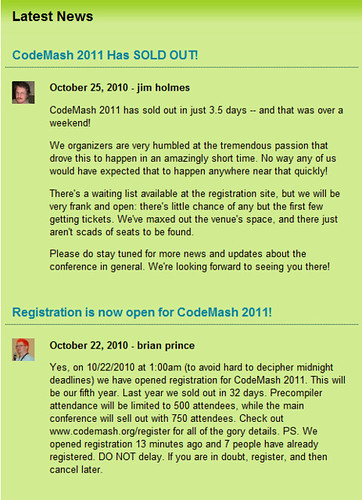
    It’s been an amazing run putting CodeMash together this year. We’ve had an amazing turnout from sponsors (we sold out of physical spots!), the best sessions from the best speakers of any CodeMash so far, an amazing lineup of PreCompiler workshops, and of course we are still a bit shell shocked that we sold out in 3.5 days. The screenshot of the CodeMash newsfeed says it all: registration open, registration closed.

    There are a huge number of things I’m looking forward to at this year’s CodeMash, but here are a few of my personal favorites in no particular order:

    • Chatting Selenium with Adam Goucher
    • Getting inspired by Chad Fowler’s keynote
    • Sitting in Mike Eaton’s Going Independent PreCompiler workshop
    • Working through a few of the exercises in the Coding Dojo put on by the smart folks at Nimble Pros
    • Seeing happy young geeks in the KidzMash sessions
    • Wandering around at the afterhours CodeMash only waterpark party
    • Enjoying some time chatting with my various community hommies who I don’t see anywhere near enough
    • Absorbing all the tremendous positive energy exuded from all the attendees – it’s this energy that recharges me and keeps me rolling for another year!

    I hope to see you there! If not, hopefully at the 2012 event!

    Wednesday, December 29, 2010

    Twitter.com/JimHolmes == “Sorry, that page doesn’t exist!”

    In case you’re looking for me on Twitter, I’m not.

    Twitter turned in to a massive time sink for me (and I didn’t have time to sink in the first place), and I was letting myself vent way too many frustrations there. It was time to take my own advice: “Enough griping, enough bitching already. Roll up your sleeves already and get to work.”

    ‘Nuff said.

    WinDirStat–Nice Disk Space Usage Visualizer

    Hard disks are cheap and greatly ease the past pain of having to manage free space, but that’s not the case for me: I have a small-ish Crucial C300 128GB Solid State Drive as my C: volume in my work laptop. It’s been absolutely awesome for working with the various VMWare virtual servers I deal with on a daily basis. The speed on the SSD goes to 11.

    The only downside is I have to be very careful about free space on the SSD. SSDs need breathing room to deal with various low-level things (go read Wikipedia’s article on them for a great overview), so I try to keep things fairly tidy and clean up unneeded files regularly.

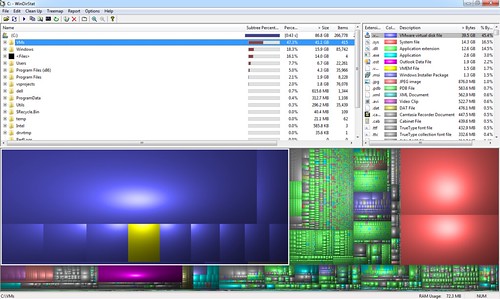
    One of the best tools I’ve found to help me with this is WinDirStat, a free GPL tool. No installation, just download and throw in a util folder somewhere. Launch it via SlickRun to be really cool.

    You get an easy to understand UI with clear indicators where your space pain points are.

    Besides, I’m a tool whore and this is yet another great thing for me to play with.

    Wednesday, December 22, 2010

    HTTP 500 Errors With Invalid Request Format After Upgrading Site to .NET 4.0

    Problem: After upgrading an ASP.NET site to 4.0 you get HTTP 500 errors with exceptions when Javascript is making web service calls: “System.InvalidOperationException: Request format is invalid: application/json; charset=utf-8.” You’ve used IIS Manager to change the application pool to specify .NET 4.0 but the problem persists.

    Solution: Change to the 4.0 framework folder (C:\Windows\Microsoft.NET\Framework64\v4.0.30319 in my case) and run aspnet_regiis.exe. You’ll need to determine which option you want – check the help before running and determine what you need.

    For whatever reason, simply changing the application pool’s version value in IIS Manager didn’t work. Using the big hammer of aspnet_regiis.exe fixed things up.

    Duplicated Setup Code in Your Tests? Refactor to a Factory!

    Your test code is production code. Treat it the same way. Don’t let cruft build up, and follow good software engineering principles – like Don’t Repeat Yourself (DRY).

    I was looking through some test code the other day and found a great opportunity to refactor out some common behavior to a factory. I do this quite often in the test frameworks I build – shove off responsibility for data and object creation to a factory so I can keep things much clearer in my tests.

    In this case, we’re testing a parser class that creates reports based on an XML file. A number of tests check the parser’s handling of malformed XML or missing elements. The basic pattern below is repeated across eight or nine tests: hardwire an XML string in the test, feed that to the parser, then check if appropriate errors and messages are generated by the parser.

       1: var reportXml =
       2:     @"<report version='4.0'>
       3:             <key>FiscalYearByBrowser</key>
       4:             <description>Shows cool stuff.</description>
       5:             <connectionString>TelligentAnalyticsAnalysisServer</connectionString>
       6:             <query>
       7:                select some SQL-fu from a magic place and return unicorns
       8:             </query>
       9:       </report>";
      10:  
      11: _report = ReportParser.Parse(reportXml);

    This is repetitious, duplicated, copied cruft. Small joke there. Moreover, it’s not readily apparent what the XML snippet’s intent is. I have to read the entire XML, then mentally unwind what I know of the structure to figure out that, oh, this snippet is actually missing the title element.

    Compare the above with this section of refactored code:

       1: _report = ReportParser.Parse(TestReportFactory.GetWithoutTitle());

    The implementation of the TestReportFactory isn’t overly important [1]; what’s important here is that duplicated behavior should be pushed out to a common area, regardless of whether it’s in the system under test or your test code itself.

    Your tests are production code. Treat them as such!

    (NOTE: Some folks, particularly the Really Smart Guy Jeremy D. Miller, make the absolutely solid case that you should never sacrifice readability in your tests for the sake of cutting duplication. It’s good to push duplicated behavior out if you can keep your tests completely clear. It’s not ok to push behavior up to base classes or elsewhere if your test turns into a vague skeleton. Readability trumps everything else.)

    [1] The TestReportFactory simply builds up a string of XML, creates an XElement from that, then uses XElement.remove() or XAttribute.remove() to drop elements or attributes as needed. The entire class is pasted below. Yes, there are a number of other ways to skin this cat. I could make things a bit more dynamic, but this worked for what I needed right now. And yes, I drove design and implementation of this factory with a separate set of tests I wrote first…

       1: internal class TestReportFactory
       2: {
       3:     private static string _reportOpen = @"<report version='4.0'>";
       4:     private static string _key = @"<key>FiscalYearByBrowser</key>";
       5:     private static string _title = @"<title>Fiscal Year by Browser</title>";
       6:  
       7:     private static string _description =
       8:         @"<description>Shows page views per browser (IE, FireFox, etc..)
       9:          for each fiscal year.</description>";
      10:  
      11:     private static string _connectionString =
      12:         @"<connectionString>TelligentAnalyticsAnalysisServer</connectionString>";
      13:  
      14:     private static string _query =
      15:         @"<query>
      16:             select non empty [Time].[Fiscal Year].Members on columns,
      17:             non empty [Dim Browser].[Browser Name].Members on rows
      18:             from [Evolution Reporting]
      19:          </query>";
      20:  
      21:     private static string _chartTypes =
      22:         @"<chartTypes>
      23:                                 <add type=""fancy 3d chart"" />
      24:                                 <add type=""plain 2d chart"" />
      25:                               </chartTypes>";
      26:  
      27:     private static string _reportClose = @"</report>";
      28:  
      29:  
      30:     public static string GetValidXml()
      31:     {
      32:         XElement doc = CreateValidReportXElement();
      33:         return doc.ToString();
      34:     }
      35:  
      36:     private static XElement CreateValidReportXElement()
      37:     {
      38:         var _outgoing = new StringBuilder();
      39:         _outgoing.Append(_reportOpen);
      40:         _outgoing.Append(_key);
      41:         _outgoing.Append(_title);
      42:         _outgoing.Append(_description);
      43:         _outgoing.Append(_connectionString);
      44:         _outgoing.Append(_query);
      45:         _outgoing.Append(_chartTypes);
      46:         _outgoing.Append(_reportClose);
      47:         XElement doc = XElement.Parse(_outgoing.ToString());
      48:         return doc;
      49:     }
      50:  
      51:  
      52:     internal static string GetWithoutQuery()
      53:     {
      54:         return CreateXmlStringWithoutElement("query");
      55:     }
      56:  
      57:     private static string CreateXmlStringWithoutElement(string elementName)
      58:     {
      59:         XElement doc = CreateValidReportXElement();
      60:         XElement element = doc.Element(elementName);
      61:         element.Remove();
      62:         return doc.ToString();
      63:     }
      64:  
      65:  
      66:     internal static string GetWithoutKey()
      67:     {
      68:         return CreateXmlStringWithoutElement("key");
      69:     }
      70:  
      71:     internal static string GetWithoutDescription()
      72:     {
      73:         return CreateXmlStringWithoutElement("description");
      74:     }
      75:  
      76:     internal static string GetWithoutConnectionString()
      77:     {
      78:         return CreateXmlStringWithoutElement("connectionString");
      79:     }
      80:  
      81:     internal static string GetWithoutChartTypes()
      82:     {
      83:         return CreateXmlStringWithoutElement("chartTypes");
      84:     }
      85:  
      86:     internal static string GetWithoutTitle()
      87:     {
      88:         return CreateXmlStringWithoutElement("title");
      89:     }
      90:  
      91:     internal static string GetWithoutVersion()
      92:     {
      93:         XElement doc = CreateValidReportXElement();
      94:         XAttribute ver = doc.Attribute("version");
      95:         ver.Remove();
      96:         return doc.ToString();
      97:     }
      98:  
      99:     internal static string GetInvalidXml()
     100:     {
     101:         return "<report>";
     102:     }
     103: }
     104:  

    Wednesday, December 15, 2010

    I’m Looking for A Great QA Team Member!

    Want to be part of a team that’s deeply involved in fundamental changes to how a company builds its software? Don’t mind hollering “Sancho! My armor!” because with some regularity you defeat those windmills?[1]  Passionate about learning and continually improving how you do work? Care more about enabling the team’s success than ticking boxes on your own resume? Think that lots of collaboration and communication with developers and stakeholders is more important than pages of requirements documents and specifications?

    Got your interest yet? If so, open up a conversation with me about joining my QA team at Telligent. We’re going to be opening up a new position in short order, and I’m looking for someone who can help us continue driving some amazing, fundamental transformations[2] at the company.

    Check out my post from last year describing the job and a bit about the environment. Most everything there still applies.

    While the general skillset and duties in that other post are still applicable, there are a few tweaks to responsibilities and skills for this new position. Our new team member will be responsible for

    • Writing automated acceptance and integration tests
    • Helping drive our Section 508 and WCAG 2 accessibility efforts
    • Assisting ongoing efforts to improve our overall development processes

    If you read my blog or follow me on Twitter you know I’m much more interested in what you’ve got in your head and heart than what you’ve got on your resume. That means I’m not overly concerned if you’re not an expert in C#, Selenium, or even .NET. I am concerned that you’re driven to learn new things. I am concerned that you’re passionate about driving cultural change. I am concerned that you think it’s better to talk frequently with folks at the start of the development lifecycle rather than wait until a dev-complete feature lands in your lap near the end of the lifecycle. (Dear fans of Six Sigma, Rational ClearQuest, and Waterfall: you likely will not thrive working with me.)

    Interested? Drop me a line! Use the contact link on this blog’s sidebar, or mail me directly: JHolmes AT Telligent DOT com.

    [1] Don’t mind working for a boss who (likely far too often) throws out weird references to books, movies, and oddball stories?

    [2]“Transformations” is lousy, over-used blabberspeak marketing crap. But you know what? The entire group my team fits in is making amazing changes to how we create our software. In this case it fits.

    Monday, November 29, 2010

    Geekspeak: Ten Tips for Making an Effective Pitch

    You’re fired up about something, but you need approval to make it happen. Maybe it’s asking for approval to go to a great developers’ conference. Maybe it’s asking for a new hire to expand your team. Maybe it’s asking for some software to help you write better code. Maybe it’s pushing for a raise for one of your subordinates.

    If you care enough about something to make a pitch for it to your management, care enough to make a GOOD pitch. Writing up a passionate, long-winded ranting e-mail or white paper might make you feel better, but you’re not going to have much of a chance of success. Spend some time preparing your pitch and you’ll have a much greater chance of winning folks over to your side.

    Here are a number of things which I’ve learned over the years through some great mentoring and a lot of hard knocks. I don’t claim to have a magical approach, and I’ve failed at a number of pitches, but overall I’ve had some pretty good success following these general concepts.

    Focus your idea

    Make sure you know what it is you want. Make sure you’re pitching for something concrete and obtainable. “We need to train our dev staff!” isn’t a focused idea, “We need to train our dev staff and can do it by sending them to CodeMash! It’s CHEAP!” is.

    Broad, unfocused ideas don’t make good pitches. They make for awesome places for you to start focusing down to a specific plan.

    Know your audience

    Understand who you’re pitching to, and what sort of information they’ll need. The bigger your pitch (read “the more it will cost”), the higher up the food chain you’ll need to go. Ensure you’re pitching to the right folks – drafting something for marketing won’t help you if you’re really trying to get new headcount approved…

    You need to do your homework and learn as much as possible about the folks who have approval authority. You’ll need to understand their motivations for the organization so that you can tailor your pitch to what they’re interested in.

    Just as importantly, you need to understand whether your goals match up with theirs. Earlier in my career I spent months, literally months, polishing up a pitch for something I felt extremely passionate about. I had to work closely with mid-level management to create a significant package and presentation for upper management, and it wore me out. The pitch ultimately was rejected because upper level leaders had completely different views and core values than I did – and I had no idea that was the case. I wasted huge amounts of my time and spent a lot of political capital at lower levels only to find out I never had a chance.

    Losing that particular pitch was one of the most demoralizing things I’ve ever had happen in my career. Not because the pitch didn’t get accepted, but because I’d so completely misunderstood the culture at the top levels of that particular company.

    Save yourself that heartache: do your homework up front by testing the waters, floating trial balloons, or whatever metaphor you prefer. See if you’ve got a reasonable chance at succeeding before you charge that hill.

    Speak the language

    More likely than not you’ll be making your pitch outside your circle of geeky colleagues to a manager somewhere in your organization. Phrase your pitch in terms your audience feels important – and that’s nearly always some form of specific, quantifiable value delivered back to the organization or your customers.

    This bears repeating because it’s critical: Tie back to specific business value. Your pitch will fail if you don’t, regardless of how big an item you’re asking for.

    Speaking about improving quality or increasing productivity is nice, but get more specifics: speak to cutting support costs. Speak to delivering features more quickly. Talk to how your idea helps the bottom line or improves relationships with your customers.

    Believe it or not, but business people actually do care about many of the same things we geeks do, they just speak a different dialect. Bridging that language gap is critical for an effective pitch.

    Understand the budget process and cycle

    Money matters. Sorry, it does. You need to know how your request will fit in your organization’s budget process and cycle. The larger your request the more you need to know.

    The budget process generally involves how requests are filed and who has approval authority for what amounts. Understanding how far up the chain your request will need to go helps you get a feel for how much prep work you’ll need to do. A $250 expense for a new SSD drive may only need your direct manager’s approval based on an e-mail. A $30K training workshop may need to go all the way to your CFO with a significant amount of backup material.

    Budget cycles matter because you’ve got to understand when you’ve got a window for a successful pitch. Larger purchases such as new hardware generally have to be planned out well in advance. You may need to be making your pitch for that $30K performance testing lab a year in advance in order to get it on next year’s budget.

    Knowing the annual budget cycle may not be enough; you may also need to understand the organization’s spend plan, too. Financial folks in companies love stability of income and expenses. They don’t like huge spikes and generally try to schedule out large expenses through the year rather than drop huge amounts of cash in one month or quarter. Looking for a really significant expense? Ensure you’re not stacking up your request when other big expenses are scheduled. Make your pitch include a target timeframe which won’t rock the spending plan. (Too much…)

    The executive summary is critical

    The higher up your pitch will go, the more important a tight, well-written opening is. You need to have one paragraph, perhaps two, which gets right to the point of what, why, and how. This opener might end up being targeted to a different audience than the rest of your pitch.

    Write your opener after everything else in your pitch is done, not before. Get all the details in place, then work REALLY HARD to distill everything down to the bare essence.

    Keep in mind this summary may be the only thing read by the person who will give your pitch the thumbs up or down. Spend the time to get this part right.

    Back it up with data

    The summary is critical, but you need meat and potatoes behind it. (Or tofu and potatoes if you’re vegetarian.) Dig around and root up some metrics that back up your pitch.

    I once had to write up a salary increase proposal for one of my subordinates. He was a very valued member of our team and was ridiculously underpaid. I compared his salary to standard wages in the region (“He can get $10K more tomorrow by quitting and going to our competitor.”). I was also able to show how his great development skills boosted the team’s velocity by 30% by tying feature estimates to actuals when colleagues worked on infrastructure he’d implemented.

    If your pitch deals with the hard engineering side of things (training to help improve how you write code, hardware for performance testing, new dev machines, etc.) then gather up metrics from tools like NDepend,  NCover, simple perf test tools, etc. Tie this to industry standards, your own Service Level Agreements, or other similar items which your audience understands – as with everything about your pitch, tie it back to specific, understandable business value.

    Don’t get carried away with flooding your audience with data, but by all means do get enough detail to make your case.

    Show options and pros/cons

    Your idea may not be the only way to skin the cat. Your idea may have drawbacks. Lay those out with the same care you spend on your idea. Doing so shows your audience that you’ve thought long and hard about your pitch and are being honest about alternatives and potential drawbacks.

    Now, that said, you don’t need to go overboard propping up the alternatives and cons. After all, you want your idea implemented!

    Be prepared to fail

    Harsh reality: your idea may not be the greatest thing since sliced bread. Others in the organization may have different opinions. The organization may not have budget. There may be a hiring freeze. There may be things going on in the organization that you don’t have knowledge of.

    Do be optimistic when making your pitch. Do work hard at getting your pitch right. Do be passionate about it.

    Just don’t let a rejected idea completely sour you on life.

    That said, if the pitch was something that’s central to your core values remember this: you can change where you work, or you can change where you work.

    Less is more

    Perhaps the overall most important point is this: Be concise. Spend the time to write a lean, concise pitch. Cut out all unnecessary cruft. Re-read, edit, re-edit, then have someone else read the pitch.

    Be sure everything in your pitch helps make your case, and ensure you’re not adding in extra fluff which doesn’t help your case.

    Don’t write ten points when nine will do.

    Tuesday, October 26, 2010

    Examples from Unit Testing 101 Talk

    I’ve given my Unit Testing 101 talk several times in the past month or two. I really love this talk because it’s fun to give and it’s obviously something I’m more than a little passionate about. It’s also a lot of fun because, unlike the majority of my talks, I’m spending the majority of the talk writing code. I don’t get to do that anywhere near enough in my day job, so it’s a kick to go do it while gabbing with community hommies!

    You can find the before and after VS 2010 solutions here on my site. The “slide deck” is really a Prezi which you can find online here.

    Tools used

    • NUnit – the test framework I wrote all the tests in
    • Rhino.Mocks – the framework I demonstrated for mocking out dependencies
    • ReSharper – Gives me a test runner, quick templates, and scads of other goodies
    • CodeRush – Another productivity tool for a runner and tons of other joy
    • AutoHotkey – Enables the next tool
    • JP Boodhoo’s BDD AutoHotKey script – makes it easy to write test_cases_with_underscores

    References I mentioned at the end of my talk:

    Books

    Thanks to everyone who attended my talks, particularly the great folks at MIGANG – that’s one of the best interactive audiences I’ve had in years!

    Sunday, October 24, 2010

    Book Review: Managing Humans

    Managing Humans by Michael Lopp. Published by Apress. ISBN 159059844X.

    I’m torn by this book. There’s a lot of really useful, interesting articles in the book, but it feels like much of the content is barely reworked from the author’s blog, Rands In Repose, and the amount of over-the-top gratuitous profanity really make the book feel unpolished. (And those who know me well are howling that I’m complaining about profanity.)

    Putting aside those two objections, I found a number of good pieces in the book. There’s a whole lot of great things about dealing with people in tense situations, and many of the pieces end up pointing back to how you should have been more aware of what was going on. For example, one article discusses how to deal with an employee who explodes about something he feels is important. The article walks through getting the person calmed down and reaching a good resolution with them – but the last paragraph throws it right back in your face with something along the lines of “But you need to remember that the person felt the only way to get your attention was to explode.”

    There’s plenty more like this, with the book covering dealing with your people, the people who manage you, and keeping a close eye on empowering your own career. Lopp uses lots and lots and lots of examples cut right out of his own career, which is really nice. The topics he cover are obviously things which are real world issues, not contrived, theoretical dealings.

    The rest of the book keeps up this same style: some good reading, some uneven content, some throw-away F-bombs and excrement quips, and occasional amazing flashes of “Wow, I really need to take a closer look at myself in the mirror” moments.

    Overall it’s a fine read. I’m not sure I got my money’s worth out of it, but it’s a good read all the same.

    Wednesday, October 06, 2010

    Upcoming Webcast: Three Tips to Improve Your Dev Process

    I’m giving my “Three Tips to Improve Your Development Process” talk tomorrow (Thursday, 7 Oct) at the Cincinnati Programmer’s Guild.

    This talk covers how you can improve your development process by implementing daily standups, regular retrospectives, and improving your estimation. These tips work regardless of whether you’re in an Agile, CMMI, or complete chaos process environment.

    I’ve just found out the Guild’s leader, Troy Davis, will be streaming the presentation on UStream. You can find the stream here. The show should start about 6:30 if everything goes well and the AV gods behave themselves.

    Monday, October 04, 2010

    Upcoming Speaking Engagements

    I’ve got a somewhat busy October for speaking!

    • This Thursday (7 Oct) I’ll be talking at the Cincinnati Programmer’s Guild hosted at Max Training. I’m giving my Three Tips to Improve Your Development Process talk. This is one of my favorite talks because it hits a few specific things you can do to improve your development environment regardless of where you work: Start daily standups, use retrospectives, and get a handle on your estimation.
    • Saturday I’ve been invited to kick off the Software Quality Firestarter in Mason (Cincinnati) with my talk on Testing Web Applications with Selenium. This is an intro-level talk, plus I pass on a LOT of hard knocks lessons we’re learning while using Selenium at my work. It’s a 60 – 75 minute talk with an incredible amount of goo crushed in to it. (There are still seats open for this event, so go register!)
    • Finally, Justin Kohnen and I are teaming up at the Dayton .NET Developers Group on 27 Oct to cover a few odds and ends in Visual Studio 2010 and .NET 4.0. I’ll be showing off some of the neat goodies helping you get rolling with Test Driven Development. I will also talk a bit about the web test framework and show some uses of it for creating simple performance tests. Justin will be covering some of the goodness around ASP.NET, configuration deployment support, and some other things. I always love co-presenting with Justin because he’s wicked smart and geeks out on all these cool toys.

    Let me know if you’re going to be at any of these events. It’s always nice to put a face to blog readers or Tweeps!

    Tuesday, September 28, 2010

    Intro to Unit Testing Presentation Video & Materials

    A couple weeks ago I drove up to the Great Lakes Area .NET Users Group to give my Intro to Unit Testing talk. The MIGANG crowd is always great to speak to – they’re interactive (always a win for a speaker), they’re interested, and there are always a bunch of pals in the audience.

    Dave Giard recorded my presentation and posted it up at the MIGANG site. You can find it here. It’s a two hour session – not just because I was long-winded (which I am), but because there was lots of great discussion about various testing topics.

    You can find my presentation materials here. I’ve got my “slide” deck (in Prezi form) and the starting/ending versions of my demo code.

    Speaking at MIGANG is always a great time, and totally worth an eight hour round trip for me from Dayton. Thanks to the gang for having me up to talk!

    Subscribe (RSS)

    The Leadership Journey